
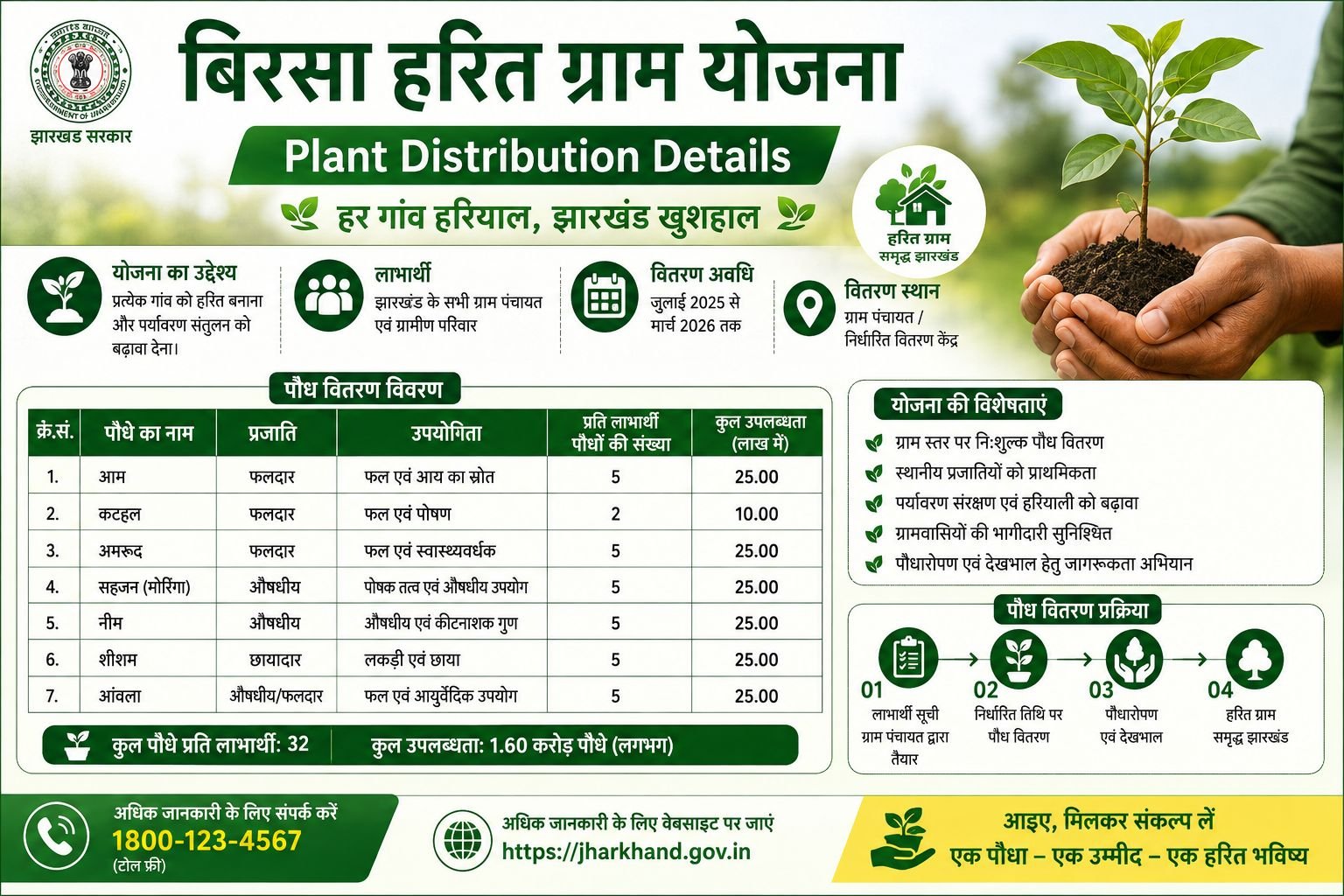
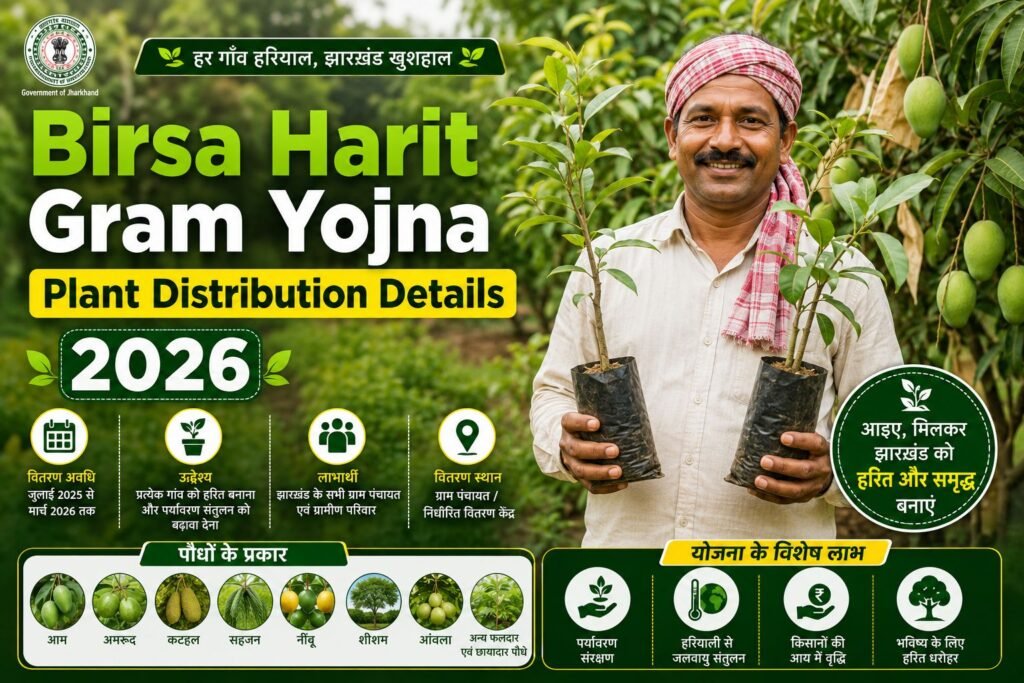
Jharkhand Rural Development Department dwara chalyi ja rahi Birsa Harit Gram Yojana ke under MGNREGA ke through se state ke chhote, seemant aur garib kisano ko banjar zameen par fruit plantation lagwane ke liye free saplings aur majdoori di jaati hai. Is yojana ka main goal kisano ki income badhana, mitti ke koto ko rokna aur environment ki protection karna hai.
Birsa Harit Gram Yojana Plantation & Benefit Estimator
Calculate fruit tree sapling quota, MGNREGA labor wages & maintenance slab breakdown
⚙️ Land & Plantation Details
📊 Estimated Plantation Quota & Financial Benefits
Aapko Birsa Harit Gram Yojna Plant Distribution Details, per-acre plant distribution models, plants ki variety (Mango, Guava, Lemon, Timber), aur application ki poori jankari niche detail mei milegi.
Key Highlights of Birsa Harit Gram Scheme 2026
| Scheme Parameter | Official Specifications |
| Managing Department | Rural Development Dept., Govt of Jharkhand (via MGNREGA) |
| Nursery Standard | NHB (National Horticulture Board) Registered Nurseries |
| Land Area Limit | Minimum 25 Decimal to Maximum 1 Acre per Beneficiary Family |
| Nurturing Period | 3 to 5 Years (Financial & Wage Support provided) |
| Usufruct Rights | 100% Rights of fruits & produce granted to the farmer |
| Employment Benefit | Up to 100 days of wage employment under MGNREGA |
Birsa Harit Gram Yojna Plant Distribution Models
Jharkhand sarkar ne zameen ke area ke according plant distribution ke do important models fix kiye hai:
1. Standard 1-Acre Model (192 Total Plants)
Agar kisan ke paas 1 acre (100 decimal) contiguous zameen hai, toh usme total 192 plants lagaye jaate hain:
| Category of Plants | Quantity | Spacing Standard | Pit Size |
| Fruit Plants (Mango / Guava / Mixed) | 112 Plants | 5m x 5m distance | 3ft x 3ft x 3ft |
| Timber Plants (Boundary Protection) | 80 Plants | 3m distance along boundary | 2ft x 2ft x 2ft |
2. Standard Unit Model (100 Mixed Plants Model)
Chhote patches (50 decimal ya kam zameen) ke liye 100 plants ka unit model follow kiya jata hai:
- Grafted Mango (Kalmi Aam): 24 Paudhe
- Layered Guava (Amrood): 24 Paudhe
- Lemon (Nimbu): 25 Paudhe
- Sahjan (Drumstick): 5 Paudhe
- Timber / Forest Trees: 22 Paudhe (Boundary par)
Types of Saplings Provided under BHGY
Districts me National Horticulture Board (NHB) dwara certified local nurseries se uchh kism ke paudhe khareede jaate hain:
Fruit Varieties: Amrapali & Mallika Mango (Aam), L-49 / Allahabad Safeda Guava (Amrood), Kagzi Lemon (Nimbu), aur Mungia Sahjan.
Timber/Forest Varieties: Arjun, Asan, Mahogani, Sagwan, aur Kusum jo boundary protection aur additional wood income dete hai.
Step-by-Step Plant Distribution & Execution Process
[ Gram Sabha Approval ] ──► [ Pit Digging & CPT Trench ] ──► [ Nursery Sapling Distribution ]
                                                                             │
[ Wage Credit via DBT ] ◄── [ 3-5 Year Maintenance ] ◄── [ Plantation & H-Staking ]
- Aavedan & Gram Sabha Selection: Gram Panchayat level par Sakhi Mandal ya Mukhiya ke dwara aavedan liya jata hai. Gram Sabha dwara eligible kisano ke naam approve kiye jaate hai.
- Site Preparation: Pit digging aur Cattle Proof Trench (CPT) ka kaam monsoon se pehle May mahine tak complete kiya jata hai.
- Saplings Transport & Distribution: Block / DRDA level par empanelled nurseries se saplings direct kisano ke khet tak pahucheye jaate hain.
- Plantation & H-Staking: Paudho ki ropai ke baad unhe hawa se bachane ke liye bamboo H-staking aur jalkund (water collection pit) banaye jaate hain.
- Wage Payment: Gaddhe khodne, paudha lagane aur pani dene ka majdoori ka paisa direct kisan ke MGNREGA Job Card account me credit hota hai.
Eligibility Criteria & Required Documents
Eligibility
- Applicant Jharkhand ka permanent niwasi hona chahiye.
- Priority Groups: SC/ST, Aadim Janjati (PVTG), BPL families, Women-headed households, PMAY beneficiaries, aur Single-parent families.
- Applicant ke paas valid MGNREGA Job Card hona compulsory hai.
- Minimum 25 decimal se 1 acre tak uplands honi chahiye.
Required Documents
- MGNREGA Job Card Copy
- Aadhaar Card
- Bank Passbook (Aadhaar linked for wage DBT)
- Zameen ka Lagan Rasid / Khatian (or Van Patta)
- Passport-size Photograph
Common Problems & Solutions
1. Problem: “Paudhe Sukh Jaane Par Replacement Nahi Milna”
- Solution: Scheme ke under 10% to 15% mortality replacement reserve rehta hai. Pehle season me paudha sukhne par aap apne MGNREGA Rojgar Sevak ya Panchayat Mate ko inform karke free replacement sapling claim kar sakte hain.
2. Problem: “MGNREGA Wage Payment Pending”
- Solution: Apne Job Card ko Aadhaar Seeding aur ABPS (Aadhaar Based Payment System) ke sath bank branch me jaakar update karayein.
Official Helpdesk & Direct Support
- Managing Department: Rural Development Department (MGNREGA Wing), Govt of Jharkhand
- How to Contact: Visit your local Gram Panchayat Office, Block Development Officer (BDO), or District Rural Development Agency (DRDA) office.
- Official Website:
[https://nrega.nic.in](https://nrega.nic.in)[https://seraikela.nic.in](https://seraikela.nic.in)/ respective district portal
Frequently Asked Questions (FAQs)
1. Birsa Harit Gram Yojna me 1 acre me kitne paudhe diye jaate hain?
1 acre model ke tehat total 192 paudhe diye jaate hain, jisme 112 faldaar paudhe (Aam/Amrood) aur 80 इमारती (Timber) paudhe shamil hain.
2. Kya paudhe lene ke liye koi charges dene padte hain?
Nahi, Birsa Harit Gram Yojana ke tehat paudhe, khad, fencing aur majdoori 100% free di jaati hai.
3. Fal ugne ke baad unpar kiska adhikar hoga?
Falo aur bagwani se hone wali poori aamdani par sirf aur sirf kisan (beneficiary) ka 100% adhikar hota hai.